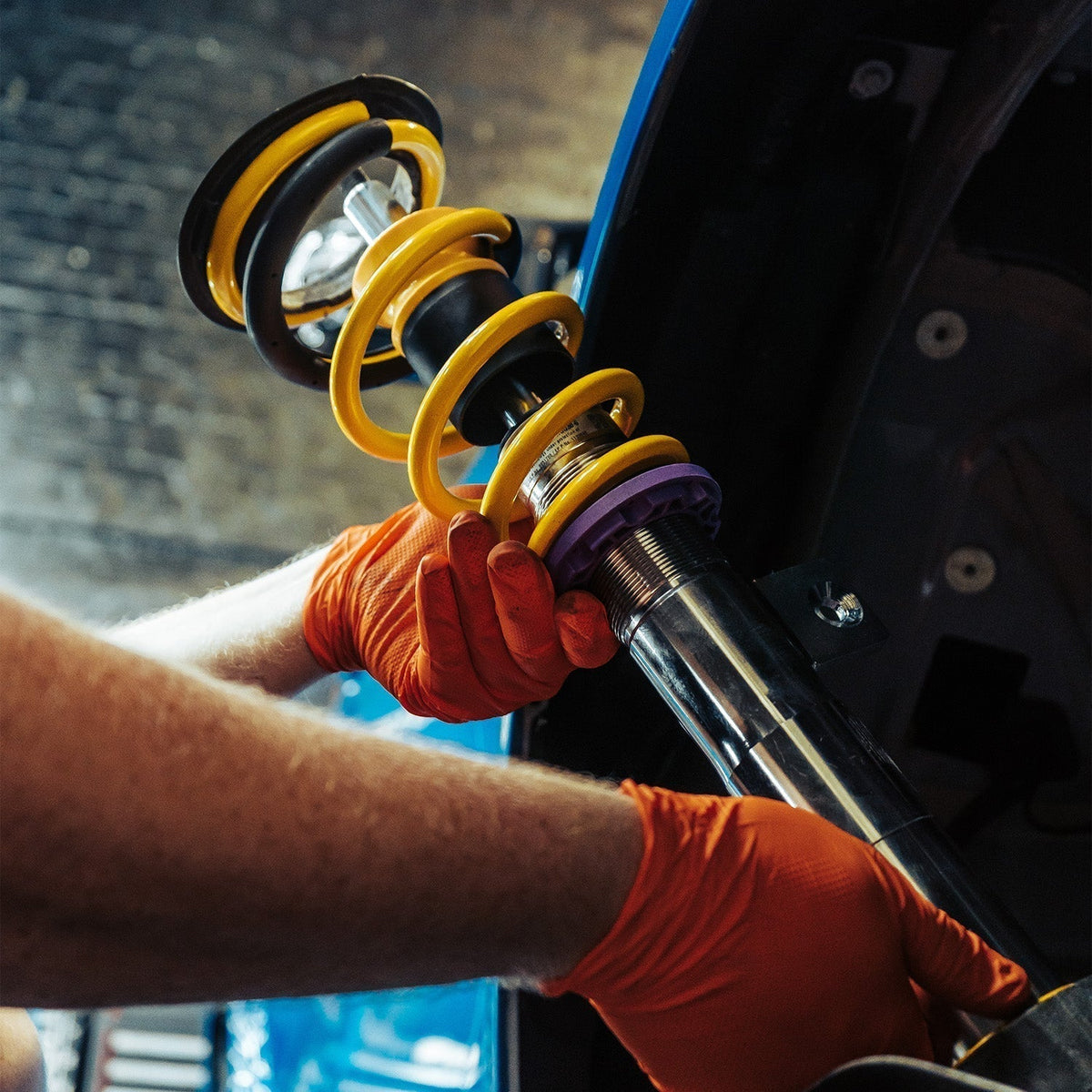
KW Suspension is one of the best-known names in aftermarket suspension, producing everything from height-adjustable spring kits for daily-driven road cars to highly adjustable coilovers and track-focused systems developed using technology from professional motorsport.
The difficult part is understanding which KW suspension setup is actually right for your car.
What is the difference between KW V1, V2 and V3 coilovers? When should you consider KW V4 or V5? How does KW Clubsport differ from a normal KW coilover? What is a KW H.A.S. kit? And what happens if your BMW, Porsche, Audi, Volkswagen or Mercedes-AMG has adaptive suspension from the factory?
At R44 Performance, KW is a suspension brand we know extremely well. We have supplied thousands of KW suspension systems to customers around the world, installed countless sets of KW coilovers and height-adjustable springs, and used KW suspension on our own project cars. Our BMW G81 M3 Touring, for example, has run KW V3 coilovers.
Although BMW applications naturally make up a significant part of our experience, this guide is designed to explain the wider KW Suspension range rather than focusing exclusively on BMW.

Shop KW Suspension Get Expert KW Advice
KW Suspension Range Explained In Simple Terms
The simplest way to understand the KW coilover range is:
KW V1 uses KW's pre-set damping with adjustable ride height.
KW V2 adds adjustable rebound damping.
KW V3 adds independently adjustable compression and rebound damping.
KW V4 adds separate low-speed and high-speed compression adjustment alongside rebound adjustment.
KW V5 moves to four-way damping adjustment, with independent low-speed and high-speed compression and rebound control.
Outside of the main Street Performance coilover range, KW H.A.S. allows adjustable lowering while retaining the factory dampers, KW DDC provides electronically adjustable KW coilovers, and KW Clubsport systems are designed for significantly more track-focused road cars.
The important point is that a higher KW number does not simply mean a stiffer suspension. As you move through the range, you gain greater control over how the dampers behave.
KW Coilover Comparison
| KW Suspension | Height Adjustable | Rebound Adjustment | Compression Adjustment | High-Speed Adjustment | Factory Adaptive Dampers Retained? | Typical Use |
|---|---|---|---|---|---|---|
| KW H.A.S. | Yes | Factory controlled | Factory controlled | Factory controlled | Yes | Adjustable lowering while retaining OE dampers |
| KW V1 | Yes | Fixed | Fixed | No | No | Road cars and straightforward lowering |
| KW V2 | Yes | Yes | Fixed | No | No | Road cars requiring basic damper adjustment |
| KW V2 Comfort | Yes | Yes | Fixed | No | No | Daily-driven cars with greater comfort focus |
| KW V3 | Yes | Yes | Yes | No | No | Performance road and fast-road cars |
| KW V3 Leveling | Yes | Yes | Yes | No | No | Performance without aggressive lowering |
| KW V4 | Yes | Yes | Low + high-speed compression | Compression | No | Advanced high-performance road use |
| KW V5 | Yes | Low + high-speed | Low + high-speed | Compression + rebound | No | High-end four-way adjustable road suspension |
| KW DDC | Yes | Electronically controlled | Electronically controlled | Application dependent | Replaces OE system while retaining electronic control | Adaptive performance suspension |
| KW V3 Clubsport | Yes | Yes | Yes | No | No | Road and track use |
| KW V4 Clubsport | Yes | Yes | Low + high-speed compression | Compression | No | Serious track-day builds |
| KW V5 Clubsport | Yes | Low + high-speed | Low + high-speed | Compression + rebound | No | High-end road and track builds |
| KW Racing | Application dependent | Application dependent | Application dependent | Application dependent | No | Dedicated competition |
Swipe the table sideways on mobile to see every column.
Exact specifications and adjustment ranges vary between individual vehicle applications, so the specification for the exact KW part number should always be checked before ordering.
Find KW For Your Car Check Fitment With Our Team
How Does A Coilover Work?

A coilover combines the coil spring and damper into a single suspension assembly, with the spring positioned around the shock absorber.
The key advantage of a coilover system is that it allows the manufacturer to engineer the spring and damper together as a complete package. Most performance coilovers also provide adjustable ride height, allowing the vehicle to be lowered within a specified operating range.
More advanced coilovers add adjustable damping, adjustable top mounts or remote reservoirs depending on the model.
Ride height should not be considered separately from the rest of the suspension setup. Lowering a car changes suspension geometry, wheel alignment, available bump travel and the operating position of the damper.
Simply setting the car as low as physically possible is therefore rarely the best approach.
What Do Compression And Rebound Mean?
Understanding compression and rebound makes the KW range much easier to understand.
Compression damping controls the damper while the suspension is being compressed.
This happens when the wheel moves upwards into the wheel arch, for example when the car hits a bump or when weight transfers during braking and cornering.
Compression damping therefore contributes to how the chassis is supported during:
- braking
- acceleration
- cornering
- bumps
- kerbs
- rapid road-surface changes
Rebound damping controls the damper while the suspension extends again.
After the suspension has compressed, rebound damping controls how quickly it returns towards its normal position.
Too little rebound control can allow the car to continue moving excessively after a suspension event. Too much can prevent the suspension from extending quickly enough to follow changes in the road surface.
What Is Low-Speed And High-Speed Damping?
This is one of the most commonly misunderstood areas of suspension tuning.
Low-speed and high-speed damping do not refer directly to the speed of the vehicle.
They refer to how quickly the damper piston is moving.
Low-speed damper movements are generally associated with relatively gradual chassis movements such as:
- body roll
- pitch under braking
- squat under acceleration
- slower weight transfer
High-speed damper movements occur during much sharper suspension events such as:
- potholes
- aggressive road joints
- kerbs
- sudden bumps
- sharp surface changes
This distinction becomes increasingly important with KW V4 and V5 suspension because these systems allow different damper movements to be adjusted independently.
KW V1 vs V2 vs V3: What's The Difference?
For most road-car owners considering KW coilovers, V1, V2 and V3 are the three most relevant products.
They all provide adjustable ride height, but the major difference is the amount of control you have over the damping.
KW V1 Coilovers

KW V1 is the entry point into the main KW Street Performance coilover range.
The damping is configured by KW specifically for each application and is not adjustable by the driver.
This means you can change the ride height within KW's specified adjustment range, but the compression and rebound characteristics remain exactly as KW developed them.
That simplicity is one of the advantages of V1.
There is no need to experiment with damper settings or worry about whether the suspension has been incorrectly adjusted. Install the suspension, set the correct ride height, complete a proper wheel alignment and drive the car.
KW V1 is particularly well suited to owners who want a high-quality coilover and adjustable lowering without needing to tune the damping themselves.
KW V2 Coilovers
KW V2 adds adjustable rebound damping.
Compression damping remains set by KW, while the rebound can be adjusted to change the character of the suspension.
Increasing or decreasing rebound allows the driver to influence how quickly the suspension extends after being compressed and how firmly certain chassis movements are controlled.
This provides noticeably more tuning potential than V1 without introducing the additional complexity of independent compression adjustment.
KW V2 makes sense for a road car where the owner wants more control over the suspension setup but does not need the full adjustment offered by V3.
KW V3 Coilovers

KW V3 is one of the most popular suspension systems in the KW range and is particularly common on high-performance road cars.
V3 adds independently adjustable compression and rebound damping.
This means the two can be tuned separately rather than one adjustment affecting the entire behaviour of the damper.
That makes it possible to refine how the vehicle responds to:
- weight transfer
- body movement
- bumps
- road surfaces
- different tyres
- different driving styles
Every V3 system still comes with a baseline setup developed by KW, so owners do not need to immediately start changing the dampers after installation.
This is an important point.
More adjustment does not mean the suspension has to be constantly adjusted. KW's recommended settings provide a strong starting point, and any changes should be made methodically from there.
Our own BMW G81 M3 Touring has run KW V3 coilovers, which is a good example of the type of car where V3 makes sense.
The G81 still needs to work properly as a road car, but it is also an extremely capable performance platform. The additional compression and rebound control offered by V3 provides considerably more tuning potential than a simple lowering spring or fixed-damping coilover.

Shop KW V3 – G80 / G82 / G87 Shop KW V3 – G81 M3 Touring
Are KW V3 Coilovers Good For Daily Driving?
Yes, KW V3 coilovers are commonly used on daily-driven performance cars.
They should not automatically be viewed as a harsh or track-only suspension simply because the dampers are adjustable.
A properly set-up V3 can retain excellent road usability while providing more control over the chassis than the original suspension.
Ride quality will still depend on factors including:
- vehicle application
- ride height
- damper settings
- wheel size
- tyre construction
- tyre pressure
- alignment
- road surface
Poorly selected settings or excessive lowering can make almost any suspension uncomfortable, which is why correct installation and setup are so important.
We cover this in more detail in our BMW X3M & X4M Ride Quality & Suspension Guide.
KW V3 vs V4 vs V5: What's The Difference?
Once you move beyond KW V3, the suspension becomes significantly more sophisticated.
The biggest difference is the ability to tune different damper-speed ranges separately.
KW V4 Coilovers

KW V4 is a three-way adjustable suspension system.
Where V3 provides independent compression and rebound control, V4 introduces separate low-speed and high-speed compression adjustment alongside rebound adjustment.
This gives an experienced driver or suspension technician considerably greater control over the way the car responds.
For example, you may want additional low-speed compression control to influence gradual chassis movements without making the car unnecessarily harsh over sharp bumps.
Because the high-speed compression circuit can be adjusted independently, these two behaviours can be tuned separately.
Relevant V4 applications also use more advanced damper construction such as external reservoirs, providing additional oil volume and allowing KW to package the additional damping technology required.
KW V4 is particularly suited to very high-performance road cars where the owner wants advanced suspension adjustment without necessarily moving into a Clubsport system.
Shop KW V4 – G80 / G82 / G87 Shop KW V4 – G81 M3 Touring
KW V5 Coilovers
KW V5 sits at the top of the KW Street Performance range.
It is a four-way adjustable suspension system providing independent control of:
- low-speed compression
- high-speed compression
- low-speed rebound
- high-speed rebound
V5 also uses KW's Solid Piston technology, bringing damper architecture derived from the company's motorsport experience into high-end road applications.
This creates an extremely broad adjustment window.
Again, this does not mean that V5 is automatically the correct choice simply because it sits above V3 and V4.
A huge proportion of performance road cars will never require four-way adjustable damping.
V5 becomes more relevant when the vehicle, tyres, driver and intended use justify that additional level of control.
KW V3 vs V4: Which Should You Choose?
For most performance road cars, KW V3 offers more than enough adjustment.
V4 becomes worthwhile when the owner specifically wants the ability to separate low-speed and high-speed compression characteristics.
In practical terms:
Choose KW V3 if you want a highly adjustable performance road suspension without making setup unnecessarily complicated.
Choose KW V4 if you understand suspension tuning, intend to develop the chassis further and want separate control over high-speed compression behaviour.
KW V2 Comfort
KW V2 Comfort takes a different approach from the normal V2.
It still provides adjustable rebound damping and ride height adjustment, but the overall calibration places greater emphasis on everyday comfort.
This makes V2 Comfort suitable for drivers who want to reduce ride height and improve chassis control while maintaining a more relaxed road-biased suspension setup.
It is particularly relevant to daily-driven cars where ride quality matters more than maximum performance.
KW V3 Leveling
Not everybody fitting performance suspension wants their car significantly lower.
KW V3 Leveling is designed around that requirement.
It combines technology from the V3 platform with a ride-height range intended to retain greater ground clearance.
This makes it useful for vehicles where the owner wants improved damper control but regularly encounters:
- poor roads
- steep driveways
- speed bumps
- underground car parks
- winter conditions
For larger or heavily used road cars, this can make more sense than aggressively lowering the vehicle.
KW H.A.S. vs Coilovers: What's The Difference?

KW H.A.S. stands for Height Adjustable Spring kit.
Unlike a full coilover system, H.A.S. retains the vehicle's original dampers.
The factory springs are replaced with KW springs and adjustable spring perches, allowing the ride height to be changed within KW's approved range.
This offers an important advantage on vehicles already equipped with adaptive dampers.
Because the original shock absorbers remain in place, the factory electronic damper functionality can also remain operational.
This is particularly popular on modern performance cars such as the:
- BMW G80 M3
- BMW G81 M3 Touring
- BMW G82/G83 M4
- BMW G87 M2
- BMW G90/G99 M5
where owners may want to lower the vehicle without immediately removing the manufacturer's electronically controlled dampers.
For a deeper look at how these kits work, read our Height Adjustable Spring Kits Guide.
Shop KW H.A.S. Kits Read: H.A.S. Kits Explained
Is KW H.A.S. The Same As Coilovers?
No.
This is an important distinction.
KW H.A.S. gives you:
- adjustable ride height
- KW springs
- factory dampers
- retained factory adaptive damping where applicable
A KW coilover replaces the dampers as well.
A system such as KW V3 therefore allows KW to engineer the spring and damper as one package and adds independent damping adjustment.
H.A.S. is generally the better option when the main objective is adjustable lowering while retaining the factory suspension technology.
A full coilover becomes more relevant when improved damper performance and additional suspension adjustment are the priority.
What Is KW DDC?

KW DDC is KW's electronically controlled coilover technology.
It is designed for drivers who want a full KW coilover system while retaining electronic adjustment of the dampers.
On compatible cars equipped with adaptive suspension from the factory, KW DDC Plug & Play connects with the vehicle's original electronics.
Depending on the application, the driver can continue using the vehicle's existing drive-mode or suspension controls to change damper behaviour.
This gives DDC a unique position within the range.
You receive:
- KW coilover suspension
- adjustable ride height
- electronically controlled dampers
- integration with compatible factory controls
This is very different from fitting a conventional mechanically adjustable V3 or V4.
Shop KW DDC – BMW F80 / F82 Shop KW DDC – Audi RS3 8Y
Can You Use KW Coilovers With Adaptive Suspension?
Yes, but the correct approach depends on the KW suspension you choose.
There are three main routes.
Option 1: KW H.A.S.
The original adaptive dampers remain in the car.
Option 2: KW DDC
The factory dampers are replaced with electronically controlled KW dampers while compatible electronic control is retained.
Option 3: Conventional KW coilovers
The factory adaptive dampers are removed and replaced with mechanically controlled KW dampers such as V1, V2, V3, V4, V5 or Clubsport.
When using the third option, an electronic cancellation solution may be required.
What Is A KW EDC Delete Or Cancellation Kit?

BMW uses the term EDC – Electronic Damper Control for electronically adjustable suspension systems.
When the factory adaptive dampers are removed, the car's control units may still expect to communicate with them.
Simply unplugging the dampers can therefore cause:
- suspension warning messages
- stored fault codes
- drive-mode errors
- electronic system warnings
KW produces vehicle-specific electronic suspension cancellation kits to solve this problem.
The modules interface with the factory electronics so that conventional mechanically adjustable coilovers can be installed without the car continually reporting missing adaptive dampers.
This is commonly referred to as:
- EDC delete
- EDC cancellation
- adaptive suspension delete
- electronic damper cancellation
The exact terminology varies, but the principle is the same.
Shop KW EDC Cancellation Kit – G8X
Does EDC Delete Remove All Driving Modes?
Normally, no.
An EDC cancellation kit is designed to deal specifically with the missing electronically controlled dampers.
Depending on the vehicle, the car can still retain other configurable systems such as:
- throttle response
- gearbox behaviour
- steering weight
- differential settings
- exhaust valve behaviour
What you lose is electronic damper adjustment because the factory adaptive dampers themselves have been removed.
The exact behaviour is vehicle-specific and should always be checked before installation.
KW DDC vs H.A.S. vs EDC Delete
These three options are worth separating clearly.
KW H.A.S.
Retains the factory dampers and the original adaptive suspension system.
Best for owners primarily looking for adjustable lowering.
KW DDC
Replaces the factory dampers with electronically controlled KW coilovers while retaining compatible electronic suspension control.
Best for owners wanting full KW coilovers without losing electronic damper adjustment.
KW coilovers with EDC cancellation
Removes the adaptive dampers completely and replaces them with mechanically controlled KW suspension.
Best when the priority is mechanical damper tuning rather than factory electronic adjustment.
There is no universally correct solution.
It depends on how the car is used and which parts of the original suspension system the owner wants to retain.
KW Street Performance vs KW Clubsport
KW Clubsport suspension sits between road-focused coilovers and dedicated motorsport suspension.
Clubsport systems are developed around significantly more aggressive use, including regular track driving, performance tyres and more track-focused wheel alignment.
This makes them fundamentally different from simply choosing a stiffer version of a normal road coilover.
The current KW Clubsport naming system broadly mirrors the Street Performance range:
- KW V3 Clubsport – two-way adjustable
- KW V4 Clubsport – three-way adjustable
- KW V5 Clubsport – four-way adjustable
Older references to KW Clubsport 2-Way, 3-Way and 4-Way generally correspond with this newer naming structure.
KW V3 Clubsport

KW V3 Clubsport provides independently adjustable compression and rebound damping.
The major difference from standard V3 is the intended operating environment.
V3 Clubsport is developed around:
- track-day use
- semi-slick and high-performance tyres
- more aggressive alignment
- greater chassis control
- higher suspension loads
Depending on the application, KW Clubsport systems can also include adjustable Uniball top mounts.
These allow additional geometry changes such as increased negative camber, which can be extremely valuable on track.
For a car that regularly sees circuit use but still needs to remain usable on the road, V3 Clubsport can make a lot of sense.
KW V4 Clubsport

KW V4 Clubsport introduces three-way adjustment.
This normally means:
- rebound
- low-speed compression
- high-speed compression
The ability to separate low and high-speed compression becomes particularly useful on circuit.
A suspension specialist can adjust how the vehicle responds to slower body movements without necessarily compromising its response to:
- kerbs
- bumps
- compressions
- aggressive surface changes
At this level, tyre choice, alignment, spring rate, ride height and damper setup should all be considered together.
KW V5 Clubsport

KW V5 Clubsport is the four-way adjustable option.
It provides independent adjustment of:
- low-speed compression
- high-speed compression
- low-speed rebound
- high-speed rebound
It also uses KW Solid Piston damper technology.
This is an extremely advanced suspension system intended for serious road and track builds where the owner or suspension engineer can make genuine use of that adjustment range.
For an occasional fast-road car, it is generally unnecessary.
For a highly developed track car that still needs to retain some road capability, the additional control can be extremely valuable.
If you are building a G87 for circuit use, our BMW G87 M2 Track Kit guide is also worth a read.
Shop KW V4 Clubsport – G8X Shop KW V5 Clubsport – G8X
Are KW Clubsport Coilovers Road Legal?
Road legality depends on the specific KW kit, vehicle and country.
Many Clubsport applications are designed for road-registered track cars and may be supplied with the relevant approval documentation in supported markets.
However, this should never be assumed simply because another KW Clubsport application has road approval.
The exact part number and local regulations should always be checked before ordering.
KW Racing Suspension
Above Clubsport sits KW's dedicated racing suspension range.
These products are intended for competition vehicles rather than conventional modified road cars.
The KW Racing portfolio includes increasingly sophisticated damper configurations, with different products providing different numbers of adjustment channels depending on the intended motorsport application.
At this level, suspension choice should be based around the complete race-car specification, including:
- vehicle weight
- aero load
- spring rates
- tyre construction
- track surface
- suspension geometry
- driver requirements
For most modified road cars and track-day builds, KW Clubsport is the point to consider before moving into dedicated racing suspension.
KW Hydraulic Lift System – HLS
KW also offers the Hydraulic Lift System, commonly known as HLS.
This is designed to solve one of the biggest problems associated with low performance cars: ground clearance.
A hydraulic lifting mechanism temporarily raises the vehicle to help clear obstacles such as:
- speed bumps
- steep driveways
- car park ramps
- loading areas
Depending on the system and application, KW HLS can be configured to lift the front axle or all four corners.
The vehicle then returns to its normal driving height once the obstacle has been cleared.
HLS is particularly useful on low sports cars and supercars where increasing the permanent ride height would compromise the desired suspension setup.
KW Classic Suspension
KW also produces suspension for older enthusiast vehicles through its Classic range.
These products bring modern KW damping technology to older and modern-classic cars.
That is especially relevant as vehicles such as older BMW M3s, Porsche 911s and performance Mercedes models move increasingly into enthusiast and collector ownership.
The objective on these cars is not always maximum lowering.
A well-developed suspension system can improve damper control and chassis behaviour while preserving the character of the original car.
KW V3 Shock Absorbers
KW also offers V3 shock absorber kits for selected applications.
These provide the damping technology and adjustability associated with V3 without necessarily converting the car to a conventional height-adjustable coilover system.
For owners who want more sophisticated damping while retaining a closer-to-standard ride-height configuration, this can be an interesting alternative.
Availability is much more application-specific than the mainstream coilover range.
KW Top Mounts And Suspension Accessories
There is more to a complete suspension setup than springs and dampers.
KW also offers application-specific suspension components including:
- adjustable top mounts
- springs
- helper springs
- adjustment extensions
- geometry components
- cancellation kits
- replacement suspension hardware
Adjustable top mounts are particularly useful on track-focused cars because they can allow additional camber adjustment.
Modern BMW M platforms such as the F80 M3, F82 M4, G80 M3, G82 M4 and G87 M2 can benefit significantly from additional geometry adjustment when running aggressive road or track setups. See our ultimate G8X M3 & M4 modification guide for the bigger picture.
Why Suspension Geometry Matters

Installing high-end coilovers without completing the correct geometry setup can prevent the suspension from working at its best.
Changing ride height alters wheel alignment.
Depending on the vehicle, lowering can affect:
- camber
- toe
- roll centre
- bump steer
- suspension travel
- driveshaft angles
After fitting coilovers or H.A.S. springs, a professional wheel alignment should therefore be considered essential.
Performance road and track cars may benefit from a more specialised geometry setup based around tyre choice and intended use.
What Is Corner Weighting?
Corner weighting measures how the vehicle's total weight is distributed across each wheel.
On a car equipped with suitable height-adjustable suspension, small ride-height adjustments can be used to improve the balance between the four corners.
This is particularly relevant for track cars.
Corner weighting should normally be completed with the vehicle configured as it will actually be driven, accounting for factors such as fuel load and driver weight.
For an ordinary road car, it may not be necessary.
For a serious track build, it can be an important part of the complete suspension setup.
Why Lower Isn't Always Better
One of the most common mistakes when fitting coilovers is assuming the lowest possible setting must offer the best performance.
It doesn't.
Lowering a vehicle excessively can reduce available suspension travel and place the damper outside its optimum operating range.
This can cause the car to:
- hit the bump stops
- lose wheel control over poor surfaces
- suffer undesirable geometry changes
- become less predictable
The correct ride height should allow the suspension to operate properly.
This is particularly important on road cars, where the suspension has to deal with considerably more surface variation than a smooth race circuit.
Our Experience With KW Suspension

R44 Performance has extensive first-hand experience with KW suspension.
Over the years, we have supplied thousands of KW suspension systems internationally and installed a wide range of KW products on customer cars.
That includes:
- KW height-adjustable spring kits
- KW V-series coilovers
- adaptive suspension conversions
- electronic cancellation systems
- track-focused coilovers
- suspension setups on modern BMW M cars
We have also used KW products on our own development and shop vehicles.
Our BMW G81 M3 Touring has run KW V3 coilovers, giving us direct experience of how the system behaves on one of BMW M's most capable modern road platforms.
Experience like this is particularly useful because suspension choice cannot be made from an adjustment-count specification alone.
How a car is used matters.
A daily-driven G81 M3 Touring, a weekend Porsche 911 and a BMW M2 used primarily for track days may all benefit from very different suspension setups even if the owners initially have similar goals.

Which KW Suspension Should I Choose?
For most customers, the decision can be simplified considerably.
Choose KW H.A.S. if:
Your main priority is adjustable lowering and you want to retain the original dampers and adaptive suspension.
Choose KW V1 if:
You want a high-quality height-adjustable coilover without needing damper adjustment.
Choose KW V2 if:
You want adjustable ride height plus simple rebound adjustment.
Choose KW V3 if:
You want a highly capable performance road suspension with independent compression and rebound adjustment.
Choose KW V4 if:
You want more advanced tuning and separate control over low-speed and high-speed compression.
Choose KW V5 if:
You require four-way damper adjustment and have a vehicle and use case capable of benefiting from it.
Choose KW DDC if:
You want KW coilovers but also want to retain electronic suspension adjustment.
Choose KW V3 Clubsport if:
Your car sees regular track use but still needs to work on the road.
Choose KW V4 or V5 Clubsport if:
You are developing a serious road-and-track build and require much finer damper control.
Choose KW Racing if:
The vehicle is being developed primarily for motorsport.
Browse All KW Suspension Ask Us Which KW Is Right
KW Suspension Frequently Asked Questions
What Is The Difference Between KW V1, V2 And V3?
KW V1 has fixed damping, KW V2 adds adjustable rebound and KW V3 adds independently adjustable compression and rebound.
All three provide adjustable ride height, but V3 gives the driver the greatest control over the damper setup.
Is KW V3 Better Than KW V2?
V3 provides more adjustment than V2, but that does not automatically make it the better choice for every vehicle.
V2 is simpler and may be more appropriate for owners who only want to adjust rebound.
V3 is better suited to drivers who want independent control of both compression and rebound damping.
What Is The Difference Between KW V3 And V4?
KW V3 provides independent compression and rebound adjustment.
KW V4 adds separate low-speed and high-speed compression control, giving the driver greater ability to tune different types of suspension movement.
What Is The Difference Between KW V4 And V5?
KW V4 is a three-way adjustable system.
KW V5 adds separate high-speed and low-speed rebound control as well, creating four-way adjustable damping.
Is KW H.A.S. Better Than Coilovers?
Neither is universally better.
KW H.A.S. is ideal if you want adjustable lowering while retaining the original dampers.
Coilovers are more appropriate if you want to replace the dampers and gain additional suspension control.
Does KW H.A.S. Keep Adaptive Suspension?
Yes, on applicable vehicles the original dampers remain installed, meaning the factory adaptive damper functionality can be retained.
Do KW Coilovers Work With BMW Adaptive Suspension?
Yes.
You can retain the original dampers with KW H.A.S., use a compatible KW DDC system, or replace the adaptive dampers with conventional KW coilovers and use the appropriate electronic cancellation system where required.
What Is BMW EDC Delete?
EDC delete refers to electronically cancelling the factory adaptive damper system after the original electronically controlled dampers have been removed.
This prevents the car from continually displaying suspension faults caused by the missing dampers.
Is KW V3 Good For Road Use?
Yes.
KW V3 is widely used on performance road cars because it combines adjustable ride height with independently adjustable compression and rebound.
Correct setup remains essential.
What Is The Difference Between KW V3 And KW V3 Clubsport?
Both offer compression and rebound adjustment, but they are developed for different uses.
Standard V3 is primarily a Street Performance product.
V3 Clubsport is designed around significantly more track-focused driving, performance tyres and more aggressive chassis setups.
What Does High-Speed Compression Mean?
High-speed compression refers to rapid damper-piston movement, not simply driving the car at high road speed.
Sharp bumps, kerbs and abrupt road-surface changes are typical high-speed damping events.
Do I Need An Alignment After Fitting KW Coilovers?
Yes.
Changing ride height affects suspension geometry, so the vehicle should be professionally aligned after installation.
Final Thoughts
The KW Suspension range becomes much easier to understand once you stop viewing V1, V2, V3, V4 and V5 as a simple progression from soft to stiff.
The real difference is control.
V1 gives you KW's pre-set damping.
V2 adds rebound adjustment.
V3 adds independent compression adjustment.
V4 separates low-speed and high-speed compression.
V5 adds separate high-speed and low-speed control on both compression and rebound.
Around those core coilovers sit specialist products for different requirements.
KW H.A.S. allows adjustable lowering while retaining the original dampers. KW DDC provides electronically controlled coilovers. KW Clubsport moves towards regular circuit driving, while KW Racing is designed for dedicated competition use.
For modern BMW owners, understanding adaptive suspension is equally important.
A BMW G80 M3, G81 M3 Touring, G82 M4 or G87 M2 can be approached in several different ways. You can retain the factory adaptive dampers with KW H.A.S., move to electronically controlled KW DDC suspension where available, or replace the factory system entirely with mechanically adjustable KW coilovers and the correct electronic cancellation solution.
There is no single KW suspension package that suits every vehicle.
The best setup is the one that matches how the car is actually driven.

Get In Touch For Your Set Of KWs
Not sure whether H.A.S., V3, V4, DDC or Clubsport is right for your car? Our sales team supplies and fits KW suspension every week. Tell us your car, how you use it and what you want from it, and we'll spec the right KW setup – including any EDC cancellation or top mounts you need.