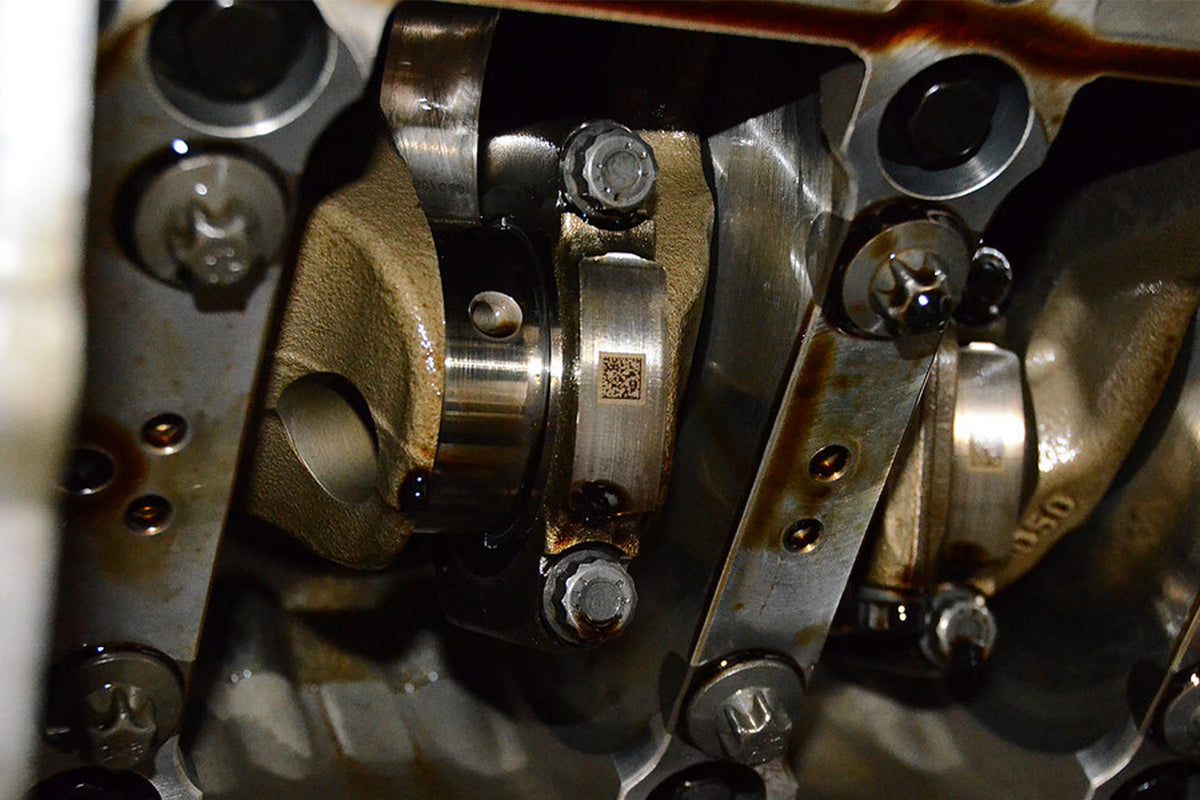
The BMW E46 M3 is one of the most celebrated M cars ever made, with its high-revving 3.2-litre S54 straight-six playing a huge part in its appeal. Producing 343hp in European specification and revving to 8,000rpm, the S54 remains one of BMW M's most characterful naturally aspirated engines. However, there are several important maintenance points prospective and existing owners need to understand, and rod bearing wear is one of the most widely discussed.

Rod bearings are not a reason to avoid an E46 M3, but their condition and replacement history should be taken seriously. Significant bearing wear can eventually damage the crankshaft or, in extreme cases, lead to complete engine failure. Preventative replacement has therefore become common amongst E46 M3 owners and BMW specialists, particularly on higher-mileage cars or examples with limited maintenance history.
In this guide, we'll explain what E46 M3 rod bearings are, why S54 rod bearing wear occurs, the symptoms to look out for, BMW's historical service actions, how bearing condition can be checked and what is involved in replacement.
E46 M3 Rod Bearings: Key Points
- The S54 uses replaceable bearing shells between its connecting rods and crankshaft journals. These bearings operate under significant load, particularly given the engine's 8,000rpm operating range.
- There is no official BMW mileage interval at which every S54 rod bearing must be replaced. However, preventative replacement is widely practised amongst specialists and owners, particularly where the car's bearing history is unknown.
- Certain early-production E46 M3s were also subject to BMW service actions relating to connecting-rod bearings. Importantly, those historical factory campaigns and the wider issue of long-term S54 rod-bearing wear should not be treated as exactly the same thing.
- Rod knock can be a symptom of serious bearing damage, but an S54's bearings can be significantly worn without producing an obvious knocking noise. Maintenance history and physical inspection are therefore particularly important.
What Are Rod Bearings On The BMW E46 M3?

Rod bearings, more accurately known as connecting-rod bearings, are semi-circular bearing shells fitted between the engine's connecting rods and crankshaft journals.
As the crankshaft rotates, the connecting rods transfer the movement of the pistons into the crankshaft. Rather than the rod and crankshaft running directly against one another, the bearing shells and a pressurised film of engine oil separate the moving surfaces.
This oil film is extremely important. In normal operation, the crankshaft effectively rides on a microscopic layer of pressurised oil rather than making direct contact with the bearing surface.
Over time, however, the bearing material can wear. If this wear becomes excessive, bearing clearance can increase and the bearing becomes less capable of maintaining the correct oil film between the connecting rod and crankshaft journal.
In severe cases, this can lead to damage to the crankshaft journal, excessive bearing clearance and ultimately catastrophic engine failure.
Why Do BMW E46 M3 Rod Bearings Wear?
There isn't one simple explanation that applies to every S54 engine.
The S54 is a particularly high-revving road-car engine. Its 8,000rpm redline, high piston speeds and performance-focused design mean its internal components operate under considerable load compared with many conventional road engines.
Several factors can influence S54 rod-bearing condition over the life of the engine, including:
- High engine speeds and bearing loads
- Bearing material and design
- Engine oil condition
- Oil temperature
- Maintenance history
- Sustained high-RPM use
- Track use
- Operating the engine aggressively before the oil reaches temperature
The relationship between S54 bearing clearances, bearing design and oil viscosity has been discussed extensively by BMW specialists and engine builders. It is overly simplistic, however, to say that all S54 bearing problems are caused solely by BMW specifying excessively tight clearances.
There is also an important distinction between BMW's historical factory service actions and the general rod-bearing wear that can be found on S54 engines decades later.
Did BMW Recall The E46 M3 For Rod Bearings?
BMW carried out factory service actions affecting certain S54-powered E46 M3s, although these are commonly referred to as rod-bearing “recalls” by owners.
BMW documentation from the period identified specific connecting-rod-bearing problems within defined production ranges.
One early BMW action covered certain M3 Coupé and Convertible models produced between October 2001 and February 2002. BMW attributed the issue to contamination within the engine lubrication system during assembly combined with unfavourable oil-pump tolerances. Corrective work included replacement of the oil pump and connecting-rod bearings.
A later BMW service action covered a broader range of S54-powered E46 M3s after BMW identified connecting-rod bearings that did not meet its required quality standards. This later action applied to certain cars produced between 12 February 2001 and 22 May 2003, depending on market and vehicle eligibility.
This is an important distinction for anyone researching an E46 M3's history. A car described as having had the “rod bearing recall” may have received factory work relating to one of these service actions, or it may simply have had a preventative bearing replacement performed by a specialist later in its life.
When buying an E46 M3, documentation showing when the bearings were replaced, at what mileage and exactly what work was carried out is considerably more useful than simply being told that the “rod bearings have been done”.
BMW's historical service actions also shouldn't be interpreted to mean that E46 M3s produced outside those windows can never experience rod-bearing wear. A factory campaign from the early 2000s and the mechanical condition of an engine more than 20 years later are two separate considerations.
Does The S54's 10W-60 Engine Oil Cause Rod Bearing Problems?

BMW specifies 10W-60 engine oil for the S54, and using oil that meets the correct specification remains important.
Because engine oil is more viscous when cold, owners should avoid placing the engine under heavy load or repeatedly using high RPM immediately after startup. Giving the engine time to reach its proper operating temperature allows the oil to reach the temperature and viscosity conditions for which the engine was designed.
This does not mean that BMW's specified 10W-60 oil is inherently responsible for S54 rod-bearing failure.

Instead, the key ownership lesson is to use the correct specification of oil, maintain sensible oil-change intervals and allow the engine oil to warm properly before demanding high RPM or heavy engine load.
On an E46 M3, oil temperature is therefore far more useful to pay attention to than simply waiting for the coolant temperature gauge to rise.
E46 M3 Rod Bearing Symptoms
One of the most commonly discussed symptoms of serious rod-bearing damage is rod knock.
Rod knock is typically a deep metallic knocking or tapping noise from the lower part of the engine. The noise may change in frequency with engine speed and can become more noticeable as the engine is placed under load.
However, this is important:
An E46 M3 does not need to have rod knock for its bearings to be worn.
By the time a genuine bottom-end knock becomes audible, bearing wear may already be severe. Owners should therefore not use the absence of rod knock as confirmation that an S54's bearings are in perfect condition.
Other possible indicators of bearing wear can include:
- Metallic material found in the engine oil
- Metallic particles or bearing material found inside the oil filter
- Abnormal wear-metal trends during laboratory oil analysis
- Evidence of low oil pressure in severe cases
- Previous bearing inspection showing significant wear
None of these should be treated as a perfect standalone diagnostic test.
If significant rod knock develops, continuing to drive the vehicle risks causing considerably more expensive damage.
What Happens When S54 Rod Bearings Wear?

The bearing shells are designed to maintain the correct relationship between the connecting rod and crankshaft while supporting a pressurised oil film.
As bearing material wears away, clearance between the bearing surface and crankshaft journal can increase.
If the bearing is allowed to deteriorate far enough, the crankshaft can begin damaging the bearing surface directly. Once this process accelerates, the crankshaft journal itself can become scored or damaged.
At the severe end of the scale, a bearing can spin within the connecting rod, resulting in extensive internal engine damage.
In extreme cases, connecting-rod failure can cause the engine to “throw a rod”, where the connecting rod physically breaks through the engine block. At this stage, repairing the original engine may no longer be economically sensible.
This is why preventative inspection or replacement is considerably preferable to waiting for obvious symptoms of complete bearing failure.
How Do You Check E46 M3 Rod Bearings?
There are several ways owners can gather information about the condition of an S54, but not every method provides a definitive answer.
Oil Filter Inspection
Inspecting the engine oil and opening the used oil filter can sometimes reveal metallic particles or bearing material.
Finding visible bearing material is a strong reason to investigate further, but a clean oil filter does not guarantee perfect rod-bearing condition.
Laboratory Oil Analysis
Used-oil analysis can identify concentrations of different wear metals within the engine oil.
The most useful way to approach oil analysis is as a trend over multiple samples, rather than treating a single test as a simple pass or fail.
Abnormal metal concentrations may justify further investigation, but oil analysis cannot conclusively tell you how much bearing material remains on every connecting-rod bearing.
Physical Bearing Inspection
Ultimately, removing the oil sump and physically inspecting the connecting-rod-bearing shells provides the clearest assessment of their actual condition.
For cars with unknown bearing history, high mileage or other warning signs, consultation with an experienced BMW M specialist is advisable.
When Should E46 M3 Rod Bearings Be Replaced?

There is no official BMW preventative replacement interval stating that every S54 requires new rod bearings at a certain mileage.
Nevertheless, preventative rod-bearing replacement has become extremely common amongst E46 M3 owners and BMW specialists.
You'll frequently see replacement discussed somewhere around the 60,000-100,000-mile range, but this should not be treated as a universal rule. An individual engine's condition depends on far more than the figure displayed on the odometer.
Factors worth considering include:
- Previous rod-bearing replacement history
- Oil-change history
- Engine maintenance
- Road versus track use
- Previous owner behaviour
- Cold-engine use
- Current mileage
- Inspection results
An E46 M3 with documented preventative bearing replacement and regular servicing may be a very different proposition from a lower-mileage example with virtually no mechanical history.
For prospective buyers, documented bearing history is therefore more valuable than mileage alone.
How Can You Reduce S54 Rod Bearing Wear?
No maintenance routine can guarantee that rod bearings will last indefinitely, but good ownership practices can help protect the S54.
Regular oil changes using BMW-approved 10W-60 oil are important. For predominantly road-driven cars, many owners choose to change their oil more frequently than the long factory service intervals originally allowed, often servicing the car annually regardless of mileage.
Cars used regularly on circuit may benefit from shorter oil-service intervals and more frequent oil and filter inspections, depending on the amount and severity of track use.
Perhaps most importantly, avoid sustained high RPM and heavy load while the engine oil is still cold.
The S54 was engineered to rev, but there is a significant difference between using its performance once properly warmed and repeatedly taking a cold engine towards the top of its rev range.
OEM vs Upgraded S54 Rod Bearings
Owners replacing their E46 M3 rod bearings have a choice between current OEM-style components and a range of aftermarket bearing kits.
Aftermarket products can use different bearing materials, coatings and specified clearances depending on the manufacturer. Some performance-orientated bearing sets use multi-layer or tri-metal construction designed to provide particular fatigue and wear characteristics.
However, it would be incorrect to assume that every aftermarket bearing automatically offers greater clearance or is inherently superior to every OEM replacement.
The specification and intended application of the individual bearing kit should always be considered.
Products such as 5150 Autosport S54 rod bearings are available for owners looking at aftermarket replacement options, particularly as part of a preventative engine-maintenance programme.
When carrying out the job, bearing shells should also be correctly measured and installed using the appropriate procedures and replacement hardware specified for the application.
How Much Does E46 M3 Rod Bearing Replacement Cost?
The total cost of replacing S54 rod bearings varies significantly depending on the components used, labour rate and how much additional preventative maintenance is completed at the same time.
Accessing the bearings requires removal of the oil sump and significant work underneath the engine. Depending on the workshop and parts selected, an E46 M3 rod-bearing replacement can therefore run into four figures once parts and labour are included.
Owners often choose to replace other accessible wear items while this work is being performed. Engine mounts, for example, may be worth inspecting while the front underside of the vehicle has already been dismantled.
The exact cost should therefore be quoted on an individual basis rather than assuming every E46 M3 bearing replacement will require the same work.
While preventative replacement isn't inexpensive, it is significantly preferable to repairing a damaged S54 crankshaft or replacing an engine following complete bearing failure.
What Should You Check When Buying An E46 M3?
When buying an E46 M3, don't simply ask:
“Have the rod bearings been done?”
Find out exactly what that means.
Ideally, the car's history should establish:
- When the rod bearings were replaced
- The vehicle mileage when the work was completed
- Which workshop performed the work
- Which bearing kit was fitted
- Whether related hardware was replaced
- Whether the crankshaft journals were inspected
- Whether the work related to an original BMW service action or a later preventative replacement
- What servicing the car has received since
For early-production cars, it is also useful to establish whether any applicable historical BMW service actions were completed.
A vague statement in an advert that the “big three have been done” is not equivalent to having invoices and supporting documentation showing exactly what work was carried out.
For a more complete overview of what to look for when purchasing one of these cars, read our BMW E46 M3 Buyer's Guide.
Are Rod Bearings A Reason To Avoid The BMW E46 M3?
No single maintenance issue tells the full story of an individual car.
Rod-bearing wear is an important part of BMW E46 M3 ownership, but it shouldn't overshadow what makes the E46 such a special M car. The S54 remains one of BMW M's defining engines, combining individual throttle bodies, an 8,000rpm redline and naturally aspirated response in a way very few modern performance engines replicate.
The important thing is to buy and maintain an E46 M3 with a clear understanding of its requirements.
Rather than assuming every engine will fail, buyers should focus on documented servicing, previous bearing work, how the car has been used and its current mechanical condition. An example with comprehensive maintenance records and preventative work can be a far more reassuring purchase than one whose history simply isn't known.
Rod bearings should therefore be viewed as an important maintenance consideration rather than something that automatically makes the E46 M3 unreliable.
And while you're staying on top of preventative maintenance, make sure you understand the other major areas associated with the platform. Read our BMW E46 M3 VANOS Guide, E46 M3 Cooling System Guide and full E46 M3 Buyer's Guide.
BMW E46 M3 Rod Bearing FAQs
Do all BMW E46 M3s have rod bearing problems?
No. Rod-bearing condition varies considerably between individual engines depending on production date, mileage, maintenance, previous repairs and how the car has been driven. Bearing wear is sufficiently well known on the S54 that preventative inspection or replacement has become common, but this does not mean every E46 M3 will suffer catastrophic rod-bearing failure.
At what mileage should E46 M3 rod bearings be replaced?
BMW does not specify a universal preventative replacement mileage for the S54. Around 60,000-100,000 miles is frequently discussed amongst owners and specialists as a preventative window, but the condition and maintenance history of the individual engine are more important than mileage alone.
What do worn E46 M3 rod bearings sound like?
Severe bearing wear can produce a deep metallic knock from the lower part of the engine that changes with engine speed or load. However, bearings can be significantly worn without producing an obvious knocking noise, so the absence of rod knock should not be considered proof that the bearings are healthy.
Can an oil analysis detect S54 rod bearing wear?
Oil analysis can help identify abnormal wear-metal trends and may provide useful supporting information, particularly when multiple samples are compared over time. It cannot conclusively confirm the physical condition of every rod bearing, however.
What oil does the BMW E46 M3 S54 use?
BMW specifies 10W-60 engine oil for the S54. Using the correct oil specification, maintaining appropriate service intervals and allowing the oil to reach operating temperature before sustained high-RPM driving are all important aspects of S54 maintenance.
Did BMW recall E46 M3 rod bearings?
BMW carried out connecting-rod-bearing service actions affecting certain S54-powered E46 M3s. One early action involved cars produced between October 2001 and February 2002, while a later action covered a wider production range on affected vehicles. Eligibility depended on production date, VIN and market, so the history of an individual car should be checked rather than assuming every E46 M3 received the same factory work.
Are E46 M3 rod bearings expensive to replace?
Rod-bearing replacement is a labour-intensive procedure because the oil sump must be removed to access the connecting rods. Parts and labour mean the total job will commonly cost well into four figures, depending on the workshop, bearing kit and any additional maintenance completed at the same time.
Are aftermarket S54 rod bearings better than OEM bearing
Not automatically. Aftermarket kits can use different materials, coatings and specified clearances, but their designs vary between manufacturers. The specification and intended use of the individual kit should be considered rather than assuming every aftermarket bearing is superior to an OEM-style replacement.