
Whenever we travel to a new market, we're never just there for the event. Yes, we go for the show, but we also go to meet the people running the scene in that country: our customers, our dealers, the workshops setting the standard, and the potential partners we haven't met yet. The culture matters just as much. We'll walk the food markets, hit the popular spots and get stuck into the nightlife, because that's what tells you how a scene really lives. Get that part right and the workshop visits and the event itself mean a lot more.
This July that market was Thailand, and the event was IMPACT Speedfest 2026 in Bangkok. It was our first real look at the city, and it didn't disappoint.

What is IMPACT Speedfest?
IMPACT Speedfest is a three-day show held at the IMPACT Arena on the edge of Bangkok. It's one of the biggest dates in the Thai calendar, and it pulls together a really wide spread of the country's car culture: European metal, a big Japanese presence, and plenty of what's trending in Thailand right now.

If you work in the industry, it's a chance to meet brands and distributors in person. If you're there as a fan, it's a rare chance to see everything from supercars to home-built projects in one hall and enjoy it all together. The energy is high, the builds are seriously good, and the crowd knows its stuff. You can tell a lot about how much a country cares about cars from an event like this, and Thailand clearly cares a lot.
Day one: landing in the Bangkok street scene
We flew in on the Thursday afternoon and got stuck straight in. Friends already out in Thailand met us and took us round some of the wildest spots in the city, and we spent that first night getting a feel for the Bangkok street scene.
The evenings here are like nothing else we've come across in the region. It's the pace of the streets, the food stalls going on every corner, the buzz along those two-lane roads that run through the city. By the end of that first night we'd got a real feel for Bangkok, the sights, the sounds and the food, before we'd set foot on the show floor. That matters to us. There's a difference between covering a show and actually understanding the place it happens in.
Day two: walking the show and getting a read on the Thai scene

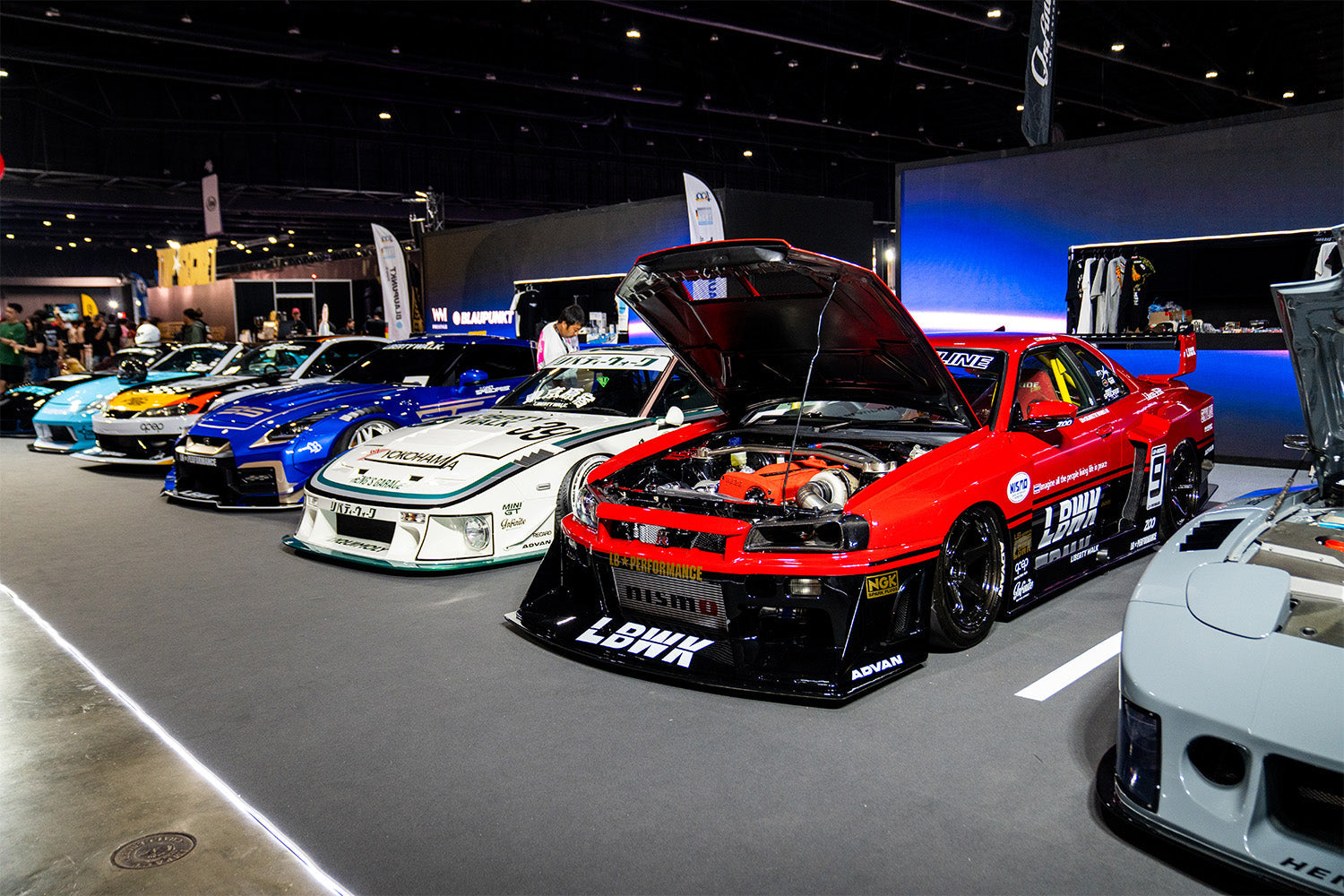
We were up early on the Friday with our three-day passes and headed to the IMPACT Arena. We spent the morning walking the floor, and the depth of it was the first thing that hit us. The wheels alone could fill an article on their own: the fitment, the choices, the sheer variety.
But the thing that really stood out was how much Japanese culture runs through the Thai market. At times it felt more like a Japanese show than a European one, in the styling, the way the cars are built, the tuning references. If you've spent any time around the Japanese scene, Thailand feels familiar straight away.
Why does Thailand build cars the way it does?
One of the most interesting things we picked up on this trip was how a lot of Thai cars actually get built, and it explains a huge amount about the local scene.
On the BMW 3 Series, for example, a common route is to buy a base-model chassis and slowly work it up to top-model spec over time. You'll see the same thing on plenty of other platforms. The passion for the car is exactly what you'd find in the UK or US. They just get there a different way.

It all comes down to tax. New imported cars in Thailand get hit with something like 300 percent tax, which is there to protect local manufacturing. To get around it, builders will often bring cars in as parts, from Japan, the UK or wherever, and then assemble them in the country, which cuts the tax bill down massively. It's the same reason the German and Japanese manufacturers all run local production plants out there: it protects their market and keeps the base cars cheap enough to feed the aftermarket.
Once the tax side clicks, the whole market makes sense. The rebadging, the way parts move around, the step-by-step builds, it's all a response to the economics, and it's produced some of the most resourceful, clued-up workshops we've seen anywhere.
On the show floor: drift BMWs, supercars and Top Secret
The floor lived up to it. Drift and custom BMWs were dotted all over the hall next to a strong showing of supercars. That mix is a big part of why Speedfest works. It isn't one marque talking to itself, it's a real cross-section.
The big one for us was Top Secret being there. The legendary Japanese tuning house, the name that made history on the GT-R and was among the first to crack 300 km/h in one, turning up in Bangkok was one of the highlights of the event. Seeing that kind of tuning royalty on the ground tells you exactly where Thailand sits on the map these days.
Workshop visit: Shift Up and the M3
Mid-afternoon we ducked out of the arena for our first workshop visit, Shift Up. They looked after us brilliantly, and the shop gave the trip a real shot in the arm. This is exactly why we travel.
The car that stopped us in our tracks was their G-series M3 It's a full-frame single-turbo build around a Precision Turbo unit, the sort of turbo that only works on exactly the right combination, mated to a 3.4-litre stroked S58 with billet internals throughout. That turbo and engine pairing sits in a real sweet spot for making big power without giving up reliability, and it was beautifully done. They had some cracking E36 builds knocking about too.
It was Shift Up who took us deeper into the rebadging and import story, where the cars come from, how the parts move around the world, and the whole logistics chain behind a Thai build. We learned a huge amount in one afternoon.
Rooftop bars and rest-stop culture
We finished the day the way you're meant to in Bangkok, catching up with friends and getting into the rooftop scene, hitting one of the city's rooftop spots for a proper night out.
We also stopped off at a rest stop that evening, which in Thailand is basically a fuel station that's turned into a car meet. If you know the Japanese rest-stop scene, you'll recognise the feeling straight away: you pull in, park up, wander round your friends' cars, have a catch-up, and the night sorts itself out. It's one of the clearest signs of how closely Thai car culture follows Japan, relaxed, community-led and completely genuine. For anyone from the West it's one of the more unusual and likeable parts of the whole scene.
Day three: Autoworks and a driver-first race series

Saturday kicked off with our good friend Andrew from Autoworks picking us up and taking us out to his place. Autoworks is a seriously impressive setup, a full-service workshop doing detailing, servicing, track prep, GT3 and GT4 prep, plus dedicated storage for luxury cars.


The standout was Andrew's GR86 race series. It's a full arrive-and-drive series on Toyota GR86s, every car built to the same spec, no modifications allowed. The only thing a driver has to work with is their own ability. It's built to put the driver front and centre rather than the car, and that's what makes it special. You can see it lifting the standard of driving out there. For us it's a great example of how quickly motorsport in Thailand is maturing, and the thinking behind it, racing the driver rather than the wallet, is something a lot of markets could learn from.
Back to the floor: Larry Chen, Dino Dalle Carbonare and a highway run
From Autoworks we headed back to the show. Saturday was noticeably busier than Friday. Friday had been more of a setup and preview day, and Saturday was when the crowds really turned up. We caught up with photographer and content creator Larry Chen, respected street-scene voice Dino Dalle Carbonare, and a few other photographers and journalists covering the Southeast Asian scene.
Then came one of the best bits of the whole trip. Shift Up handed us the keys to their GAT M3 for a proper run on the highway. Driving the car after seeing exactly what had gone into it put the whole visit in a different light. You appreciate every decision a lot more once you've felt the result. It took everything we gave it and asked for more.
The dealer tour: four stops across Bangkok
Mid-afternoon we left the venue and started our dealer tour, four stops lined up across the city.
Race Tool was first, and they're all about the N54. We had a look at a single-frame stroker N54 build while we were there. Clean shop, and they really know their stuff.


Our second stop was a Toyota-focused workshop full of GR86 work. It was one of the most useful visits of the day for getting our heads round how Thai workshops run day to day: what parts they can get hold of, how they source them, how they look after their customers. It was here we spotted some big-name brands on the cars, Downstars and Golden Wrench among them. Seeing our supplier partners' work reach all the way out to Thailand from the UK and US was a good moment.
The third stop was a true 2JZ specialist, a drift builder who also turns out serious drag cars on Mk4 Supras. We had a wander round with the owner, and it turned out plenty of the team already knew R44 through our G87 M2 drag car. That build gets around, and bumping into its reputation on the other side of the world never gets old. Brilliant atmosphere in that shop too, loads of laughs and a lot of shared passion.


Last up was MTech, one of our OG dealers and a long-standing supply partner. The place is exceptional: room for handovers, its own detailing bay, and luxury storage built around the cleverest system we saw all trip. It's an automated tray-retrieval setup where you enter a tray number into a control box and it works out the quickest way to shuffle the cars and get yours out.


Then came the moment of the trip. We walked in to see our R44 logo up on the wall, and a box that had landed only that week with our branding on it, sitting right next to the car they were working on. That kind of reach, thousands of miles from home, is what makes all the travelling worth it.
A chaotic finish
We got back to the hotel that evening to do some editing, then worked out that our "Sunday evening" flight was actually 00:41 Sunday morning, which left us about four hours to pack and get to the airport. Bit of a scramble, but a good way to end it. We grabbed our bags, made it out, and that was Bangkok.
What we took away from Thailand
Thailand caught us off guard in the best way. The tax and custom-build story explains a market that solves its problems differently to anything in the West, and does it with real ingenuity. The scene follows Japanese car culture more closely than almost anywhere, from the rest stops to the JDM influence to the hero status of a name like Top Secret. The motorsport side is coming on fast, with driver-first series like Andrew's GR86 arrive-and-drive setting the tone. And the workshops are full-service operations that stand up against anything in Europe.
More than anything, the trip showed us how far the R44 name and our partner brands now reach. Our logo on a wall in Bangkok, our parts on cars on the far side of the world, our G87 M2 drag car recognised by builders we'd never met. That's the payoff for turning up in person. We'll be back.
Frequently asked questions
What is IMPACT Speedfest?
IMPACT Speedfest is a three-day car show held at the IMPACT Arena just outside Bangkok, Thailand. It brings European, Japanese and Thai car culture together across supercars, drift builds and enthusiast projects, and it's a key meeting point for workshops, distributors and the public.
Why are new cars so expensive in Thailand?
New imported cars in Thailand face tax of around 300 percent, which is designed to protect local manufacturing. To manage that, a lot of builders import cars as parts and assemble them in the country, which brings the tax bill down a long way. It's also why the big German and Japanese manufacturers run local production plants there.
Why does the Thai car scene feel so Japanese?
Japanese car culture runs deep in Thailand, from JDM-influenced builds and tuning references to rest-stop car meets that mirror Japan's own. Legendary Japanese tuners like Top Secret showing up at events like Speedfest only reinforces how strong that link is.
What is a Thai "rest stop" car meet?
In Thailand a rest stop is basically a fuel station that doubles as an informal car meet. People pull in, park up, walk round each other's cars and have a catch-up. It's very close in feel to the Japanese rest-stop scene.
Who is R44 Performance?
R44 Performance is a UK-based BMW performance and tuning specialist, supplying parts and expertise to enthusiasts and workshops around the world, including a growing dealer network in markets like Thailand.